A mobile crane’s hydraulic system is made up of five core components — the pump, control valves, cylinders, motors, and reservoir/filtration circuit — and roughly 70% of hydraulic failures in the field trace back to contamination or low fluid that a five-minute daily check would have caught. If you’re running or renting cranes, understanding what each component does isn’t optional knowledge for engineers only. It’s the difference between catching a $200 seal leak on Monday morning and paying for a $15,000 cylinder replacement three weeks later, mid-project, with a client watching.
Table of contents
cnxjcm
Why Hydraulics Are the Real Muscle Behind Every Lift
Here’s something a lot of operators don’t think about: a crane’s diesel engine doesn’t lift anything directly. It just spins a pump. Everything you see happening — boom raising, outriggers extending, load rising off the ground — is hydraulic fluid doing the actual work under pressure, sometimes exceeding 350 bar (5,000 psi) in the main circuits of a rough terrain crane.
That’s why hydraulic health isn’t a side issue in crane performance — it IS the performance. A crane rated for 50 tons with a worn pump or degraded fluid won’t lift anywhere close to its rated capacity smoothly, even if the structural steel is perfectly fine. If you’re comparing tonnage options for a project, it’s worth reading how to choose the right crane tonnage without overpaying alongside understanding that hydraulic condition affects real-world lifting performance just as much as the spec sheet.
The Hydraulic Pump: Where Everything Starts
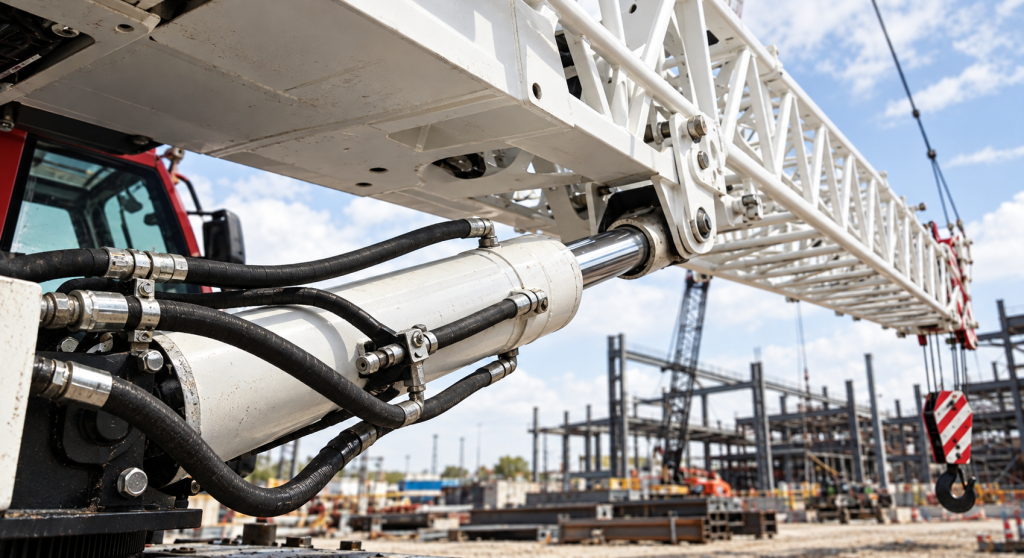
The pump is the heart of the system, and most mobile cranes use a variable displacement piston pump rather than a fixed-gear pump — because load demands change constantly during a lift cycle. When you’re barely lifting, the pump reduces output; when you need full boom speed under load, it ramps up flow instantly.
What Goes Wrong
Pump wear shows up as a whining or growling noise, especially under load, and as sluggish response when the operator moves the joystick. A worn pump can’t build pressure fast enough, so the boom feels ‘lazy.’ On older units we’ve serviced, pump failure was almost always preceded by weeks of ignored aeration noise — air getting into the suction side because of a loose fitting or low reservoir level.
Control Valves: The Traffic Cops of the System
Control valves decide where hydraulic fluid goes and how much of it gets there — to the boom cylinder, the winch motor, the outrigger jacks, or the swing motor. On modern rough terrain and truck cranes, these are usually proportional valves controlled electronically, giving operators fine, smooth control instead of abrupt on/off movement.
A sticky or worn valve spool causes jerky, inconsistent motion — the boom might jump instead of gliding. This matters enormously during precision lifts, like setting a beam onto anchor bolts. For a deeper look at how superstructure design ties into control precision, see understanding the truck crane superstructure.
Cylinders and Motors: Where Pressure Becomes Motion
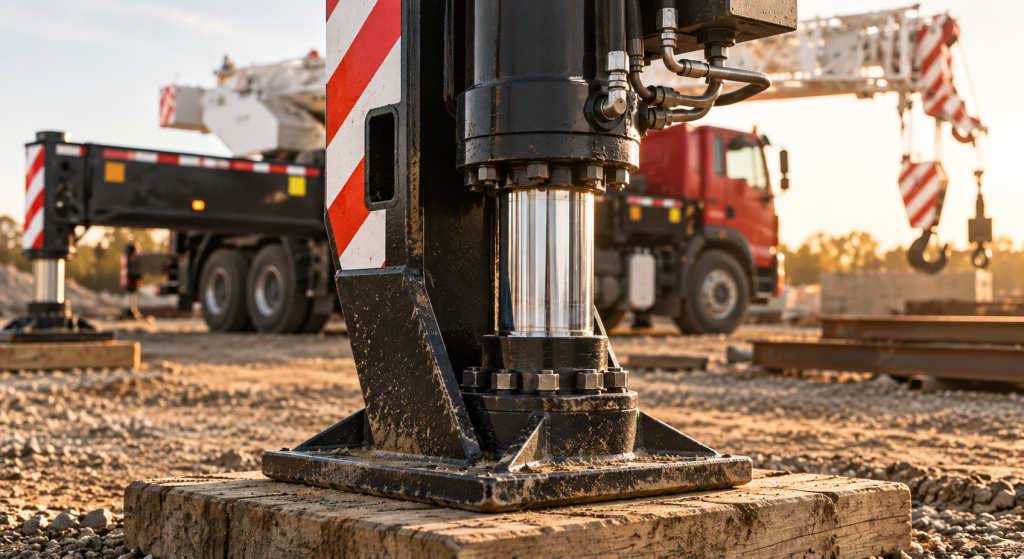
Cylinders convert hydraulic pressure into linear force — this is what raises the boom, extends the telescoping sections, and pushes the outriggers down. Hydraulic motors, by contrast, produce rotary motion, driving the winch drum and the swing/slew mechanism.
The Seal Problem Nobody Talks About Enough
Cylinder rod seals take a beating from dust, especially on rough terrain jobsites in sandy or muddy conditions common across the Middle East and parts of Africa. A seal that’s even slightly compromised lets in grit, which scores the cylinder wall — and once that happens, you’re not fixing it with a seal kit anymore, you’re rebuilding or replacing the cylinder.
Real-world example: A crane rental company operating in a coastal Gulf project noticed one outrigger cylinder creeping down overnight, dropping the crane out of level by a few millimeters. Their inspection caught a hairline seal leak before it became a full outrigger failure mid-lift — exactly the kind of check we cover in mobile crane outrigger setup and leveling checks.
Reservoir, Filters, and Fluid: The Unsexy Part That Matters Most
If you only remember one thing from this article, make it this: contaminated hydraulic fluid causes more crane downtime than any single mechanical part failure. Fluid does three jobs at once — transmits power, lubricates internal components, and carries away heat. When it’s dirty or low, all three jobs suffer simultaneously.
- Filters: Most systems have return-line filters rated around 10-25 microns. A clogged filter bypasses dirty fluid straight back into the system — silently.
- Fluid color: Clear amber is healthy. Milky or foamy fluid means water contamination. Dark brown or black with a burnt smell means overheating and additive breakdown.
- Fluid level: Should be checked with the boom fully retracted and outriggers stowed — checking with the boom extended gives a false low reading.

The 5-Minute Daily Inspection Routine
You don’t need a full teardown every morning — you need a fast, disciplined visual and functional check before the engine even reaches operating temperature. Here’s the routine we recommend to fleet operators:
Before Startup
- Check reservoir fluid level (boom stowed, engine cold)
- Inspect all visible hoses and fittings for wet spots, cracking, or bulging
- Look under the crane for overnight puddles or drips
After Startup, Before First Lift
- Listen for unusual pump noise during the first 60 seconds of idle
- Cycle outriggers out and back — watch for jerky or uneven movement
- Slowly raise the boom a few degrees and check for smooth, consistent motion
- Check hydraulic filter indicator gauge, if equipped
Skipping this because you’re behind schedule is exactly how a small leak becomes a mid-lift shutdown. Crews who treat this as routine, not optional, consistently report fewer unplanned hydraulic repairs across a season.
Seasonal and Climate Factors That Change the Checklist
Hydraulic fluid behaves differently at 45°C in the Gulf than it does at -15°C in a CIS winter jobsite, and your inspection priorities should shift accordingly.
Hot Climates
Heat thins fluid, reducing lubrication film strength and accelerating seal wear. Check reservoir temperature gauges more frequently and consider higher-viscosity-index fluid for desert operations.
Cold Climates
Cold fluid is thick and slow to flow, causing sluggish operation right at startup — this is normal, but running the crane hard before proper warm-up accelerates pump wear. A 5-10 minute idle warm-up cycle, gently cycling functions at low pressure, prevents this. Crews working remote pipeline routes in colder terrain deal with this constantly — it’s covered in more depth in pipelaying projects in remote terrain and crane selection.
How Hydraulic Health Connects to Crane Safety Systems
It’s worth noting that hydraulic performance and electronic safety systems work together, not separately. A crane’s LMI (load moment indicator) and anti-two-block sensors rely on consistent, predictable hydraulic response to function accurately — if the hydraulic system is sluggish or inconsistent, safety system readings can lag behind actual boom position or load state.
This is one more reason hydraulic maintenance isn’t just an efficiency issue — it’s a safety one. For the full picture on how these systems interact, see mobile crane safety systems explained.


