In remote pipelaying, crane selection is the single biggest schedule lever you control. The wrong machine — too light, too road-bound, or too slow to redeploy — turns a 90-day spread into a six-month mud fight, while the right mix of pipelayers, rough terrain cranes, and truck cranes keeps welders, fitters, and trench crews moving in lockstep. The trick is matching crane type to terrain reality, not to a spec sheet.
The Hidden Cost of Picking the Wrong Crane
Most pipeline delays don’t come from welding or trenching. They come from lift logistics. A crane that can’t reach the next joint, can’t travel between spreads without a lowboy, or sinks into wet clay every morning quietly eats two to four hours a day per crew.
Multiply that by 30 working days and you’ve lost a month before anyone notices. On a 60 km cross-country gas line, one Central Asian contractor we worked with traded out their road-bound truck cranes for rough terrain units mid-project — and recovered roughly 18 days over the next two spreads simply because the cranes could self-relocate between weld stations instead of waiting on transporters.
The lesson: lift productivity isn’t measured in tons. It’s measured in lifts per shift, and that number lives or dies by mobility.
Match the Crane to the Terrain, Not the Pipe
Buyers obsess over pipe diameter and weight. That matters — but terrain dictates which machine can actually deliver the lift.
Soft ground and active trenches
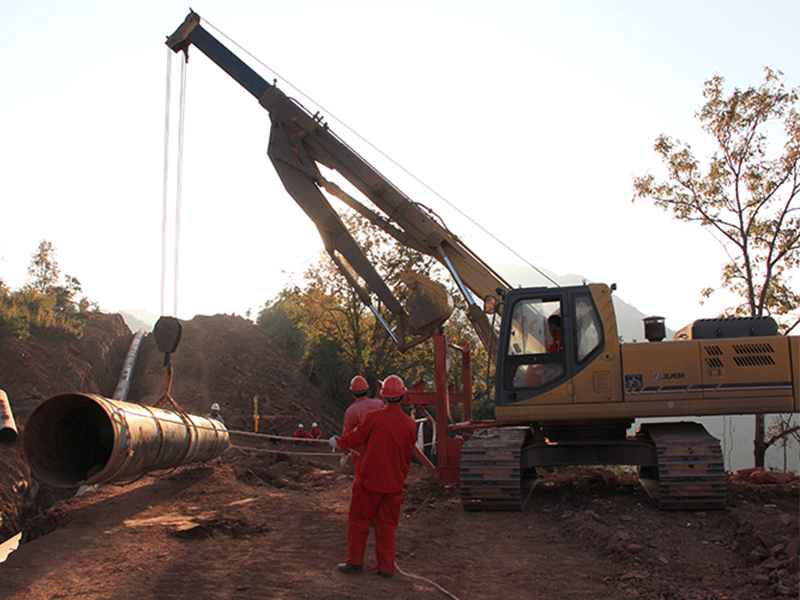
Dedicated pipelayers with tracked undercarriages and counterweights win here. Their side-boom geometry is built for lowering-in along an open ditch, and they don’t need outriggers.
Unpaved access roads, graded ROWs, and slopes
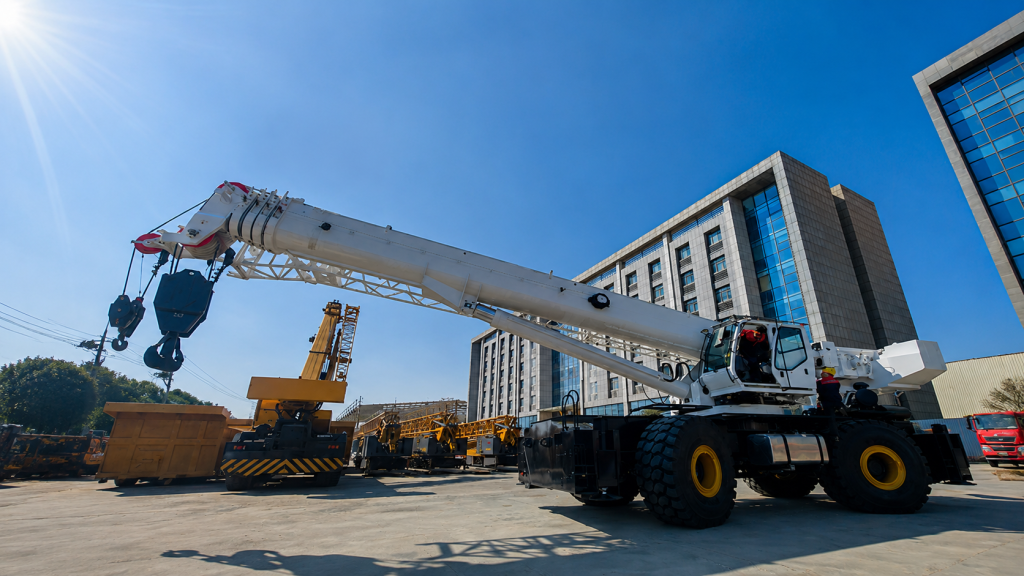
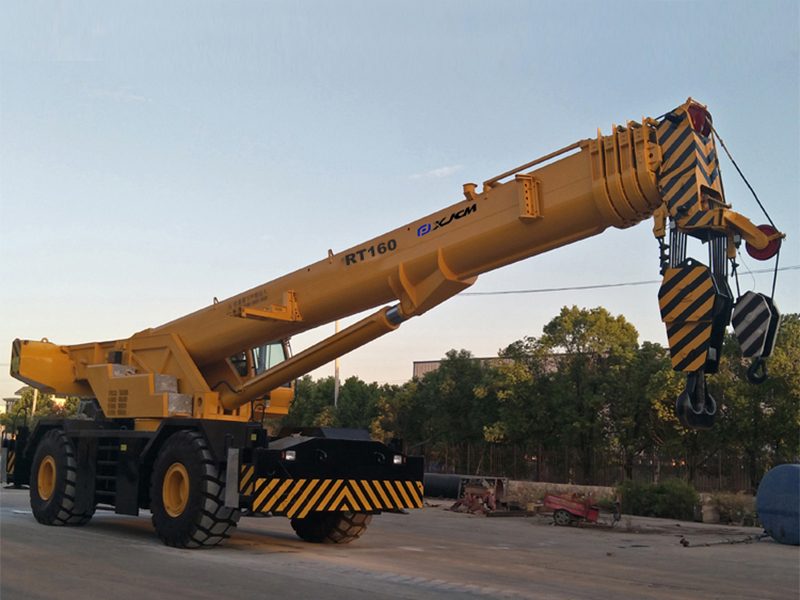
This is where rough terrain cranes shine. Four-wheel drive, four-wheel steer, large flotation tires, and high ground clearance let them traverse the right-of-way under their own power. A 30 to 70 ton RT will handle most stringing, fitting, and tie-in work on a typical onshore line.
Compacted roads and yard work
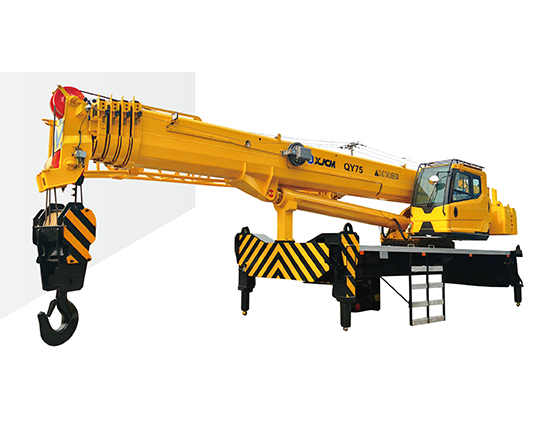
Truck cranes are faster between sites and cheaper per hour. Use them where the access is good — pipe yards, road crossings, station construction.
For a deeper breakdown of how RT cranes perform in remote service, see why rough terrain cranes suit mining and remote areas.
Sizing Tonnage: The 1.5x Rule and Why It Matters
Pick a crane rated for at least 1.5 times the heaviest pipe section at the working radius — not at minimum radius. This is where most procurement teams trip up.
A 30-ton crane lifting at 3 meters is one thing. The same crane at 12 meters might only handle 6 tons. On a typical 48-inch pipe spread with sections weighing 8 to 12 tons and working radii of 8 to 14 meters, you usually need a 50-ton class machine or larger to keep safety margins intact and avoid load chart gymnastics on every lift.
- Small-diameter lines (under 24″): 20–30 ton RT cranes are usually sufficient.
- Mid-diameter (24″–36″): 50–70 ton RT cranes hit the sweet spot.
- Large-diameter (36″–56″): 70–100+ ton cranes, often paired with dedicated pipelayers for lowering-in.
Curious how much an RT can actually pull at radius? Our breakdown on rough terrain crane lift capacity walks through the chart math.
Pipelayers vs. Rough Terrain Cranes: When to Use Which
Here’s the honest answer: you usually need both. They’re not competitors — they’re partners.
Pipelayers do one thing extremely well: hold a strung pipe over an open trench while welders work, then lower it in. They’re tracked, slow, and purpose-built. They don’t do general lifting.
Rough terrain cranes do everything else. Unloading trucks at the stockpile, stringing pipe along the ROW, lifting bend sections into place, setting valves at block stations, supporting hot taps. They’re the utility infielder of the spread.
For example, a contractor laying a 40 km crude line through hilly terrain in East Africa ran three pipelayers on the lowering-in crew and rotated two 55-ton RT cranes across stringing, fitting, and tie-in. The RTs covered roughly 80% of all lifts by count, even though the pipelayers got most of the photos.
Mobilization: The Spec Nobody Reads but Everyone Pays For
How fast can your crane get to the next spread? In remote pipelaying, this question matters more than peak lift capacity.
Tracked pipelayers need a lowboy and a permit every time they move more than a kilometer or two. That’s fine for lowering-in, where the crane crawls alongside the trench. It’s punishing if you’re leapfrogging across 5–10 km spreads.
Rough terrain cranes drive themselves at 25–35 km/h. They can self-deploy across an entire spread overnight. Truck cranes are even faster on roads — 70+ km/h between sites — but lose hours every time the ROW turns to dirt.
A useful rule: if your spreads are short and clustered, lean on RTs. If they’re separated by long stretches of paved access, mix in truck cranes to cover the highway-accessible work.
Customization for Local Conditions and Chassis
Off-the-shelf cranes rarely fit remote pipeline jobs perfectly. Heat, dust, altitude, fuel quality, and local chassis preferences all push for some level of customization.
Common adjustments we see on export pipeline orders:
- Heavy-duty air filtration for desert and high-dust environments.
- High-ambient cooling packages for Middle East and African summers.
- Cold-start kits and arctic hydraulic fluid for CIS winter projects.
- Local chassis mounting — putting a Chinese-built crane superstructure on a Russian, Iranian, or African truck chassis the customer already operates.
- Extended boom or jib options for cross-trench reach without repositioning.
A pipeline EPC in Kazakhstan, for instance, ordered crane superstructures mounted on locally sourced 8×4 chassis to simplify spare parts and registration. That kind of flexibility cuts customs headaches and shortens lead time on follow-up units.
Lift Planning for Long Linear Sites
Pipeline lifts aren’t building lifts. You’re not setting one massive load in one place. You’re doing hundreds of similar lifts spread over tens of kilometers — and the planning problem is logistics, not lift engineering.
Three planning fundamentals that pay off on remote spreads:
1. Standardize the lift
If every pipe section is the same length and weight, lock in one boom configuration and one set of rigging. Crews stop thinking and start producing.
2. Pre-position cranes ahead of the weld front
Don’t let cranes chase the welders. Move them forward overnight so they’re ready when the shift starts.
3. Build redundancy into your fleet
One crane down on a remote spread means the whole spread stops. Plan for at least one spare RT per three working cranes, and keep critical spares — slew bearings, hydraulic pumps, boom cylinders — on-site, not in a port warehouse 800 km away.
After-Sales Support: The Multiplier Nobody Quotes
In a city, a broken crane is a phone call. In the middle of a Kazakh steppe or Saharan desert, it’s a week-long crisis. After-sales support isn’t a nice-to-have on remote pipelaying — it’s the multiplier that decides whether your fleet runs at 85% utilization or 60%.
What to demand from any supplier before signing:
- Local or regional spare parts stock — not just “available from factory.”
- Remote technical support in your operators’ language.
- Operator and maintenance training delivered on-site, in person.
- Documented mean time to repair for major components.
- Pre-shipped consumables: filters, hoses, seals, cylinders — enough for 12 months of operation.
If your supplier can’t answer those questions clearly, the bid is too cheap for a reason.
Putting It Together: A Practical Selection Checklist
Before you finalize a crane fleet for a remote pipelaying job, walk through this list:
- Pipe weight and diameter — establishes minimum tonnage.
- Working radius range — the real capacity number, from the load chart.
- Terrain profile — soft, graded, paved, or mixed.
- Spread length and spacing — determines mobility needs.
- Climate envelope — temperature, dust, humidity, altitude.
- Local chassis and parts compatibility — affects long-term operating cost.
- Support footprint — how close is the nearest service tech?
Get those seven answers right and your fleet decision is 90% made. From there, it’s a question of matching tonnage classes — somewhere across the 30-ton, 70-ton, or 100-ton classes — to the specific pipe spec.
At cnxjcm, we’ve built rough terrain cranes, truck cranes, and pipelayers for pipeline contractors across more than 40 countries, with custom configurations for local chassis, climate, and chassis registration rules. If you’re scoping a remote pipelaying project and want a second opinion on fleet mix, get in touch — we’ll help you spec it right the first time.


