A small self-erecting tower crane is designed for fast deployment on compact jobsites. Instead of assembling mast and jib section-by-section with an assist crane, the unit is positioned, leveled on outriggers, and unfolded into working configuration using an integrated hydraulic erection system. Many models also support remote control operation and are built to reduce high-level work during erection and dismantling.
This guide outlines the typical erection sequence for small self-erecting tower cranes, along with practical setup checks that help crews start lifting safely and efficiently.
Table of contents
cnxjcm
How erection differs by crane type
Setup procedures vary by crane design:
- Mobile crane crews deploy outriggers, install counterweights, and configure the boom before starting work.
- Tower crane crews assemble traditional tower cranes from sections and may use an assist crane and plan tie-ins as the building rises.
- Small self-erecting tower cranes travel in a compact state and unfold into working position through a controlled hydraulic erection sequence.
This article focuses on the self-erecting type commonly used for tight-access sites and short-to-medium duration projects.
What makes a small self-erecting tower crane different
Small self-erecting tower cranes use a folding structure that travels compact and erects on site through hydraulic unfolding rather than high-level manual assembly.
Across common configurations in this class:
- Max hoisting height is often in the 16–25 m range
- Max working radius can reach up to 27 m
- Max lifting capacity is typically about 1–4 tons depending on the model and working radius
- Erection time is commonly around a 10-minute class setup
Capacity is not constant across the full working area. As radius increases, allowable load typically decreases, so lift planning should follow the model’s load chart.
Step-by-step: how a small self-erecting tower crane is erected
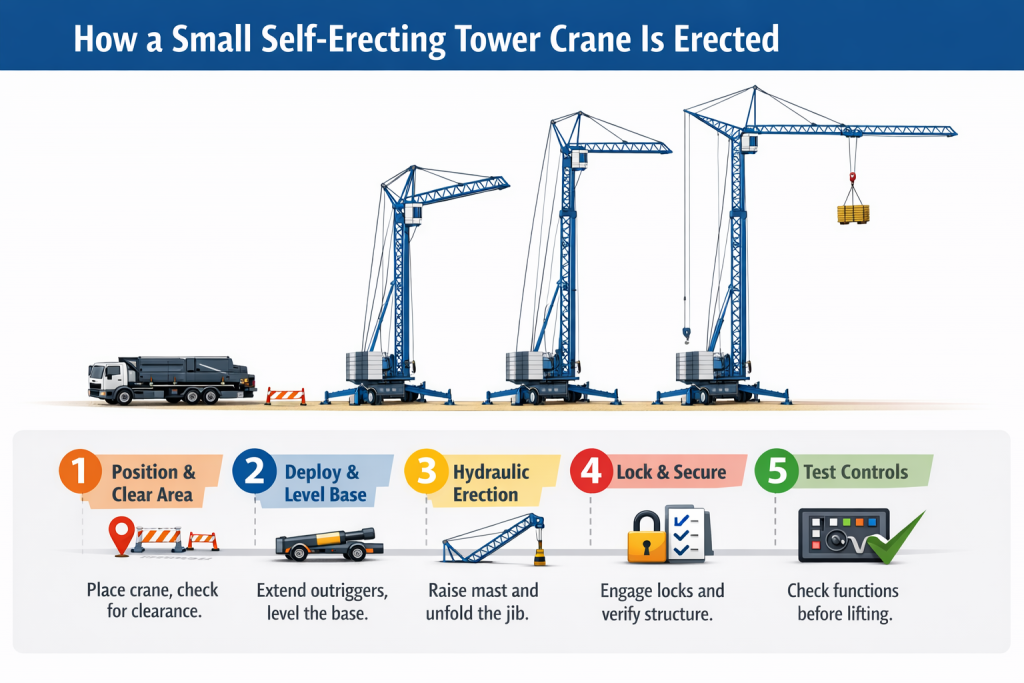
Even with rapid setup design, erection is a controlled sequence. The goal is stable support, correct geometry, and verified safety functions before production lifting begins for the safe use of cranes.
Step 1 — Position the crane for coverage and clearance
Position the crane so it can cover the work zone within the planned radius. Confirm:
- Clear slewing area and overhead hazards
- Space for erection movement and swing tail clearance
- An exclusion zone for the erection cycle
Good positioning reduces repositioning later and improves daily workflow.
Step 2 — Deploy outriggers and level the base
Deploy outriggers to the specified working span and level the crane using the machine’s indicators. Leveling influences:
- Structural geometry after erection
- Handling feel during slewing and luffing
- Stability when working closer to maximum radius
Step 3 — Run the hydraulic erection sequence
Use the integrated hydraulic system to raise the mast and unfold the jib through a controlled arc. The crane transitions from travel state into working configuration.
Step 4 — Locking, securing, and structure verification
After erection, confirm all locking and securing points are in the correct position. Depending on configuration, some connection steps may be designed to occur during erection to reduce manual intervention.
Do not begin production lifting until securing points and setup confirmations are complete.
Step 5 — Functional checks before lifting
Verify core functions under no-load or controlled conditions:
- Hoisting response and smooth speed control
- Slewing and braking behavior
- Luffing response if equipped
- Limit functions, emergency stop, and overload protection
- Control response and jobsite visibility
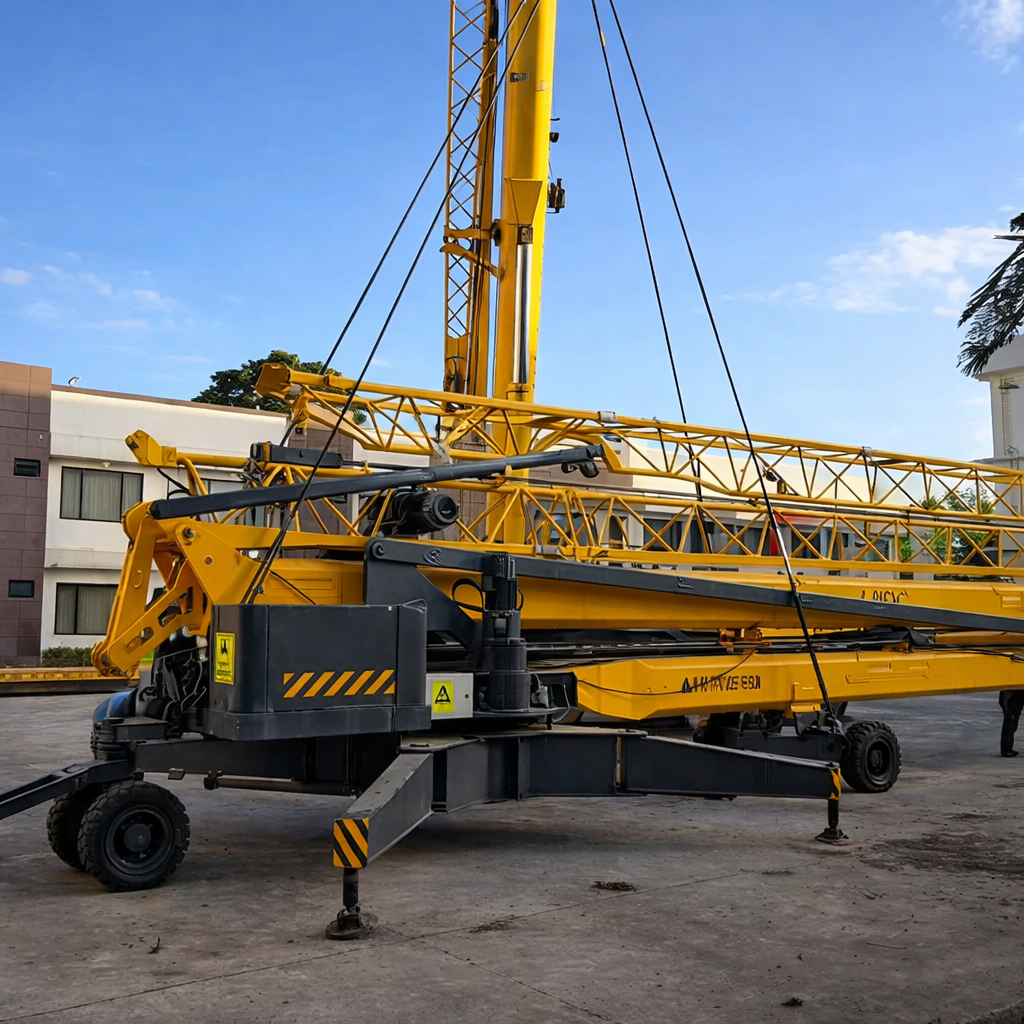
Do self-erecting tower cranes require an assist crane?
Many small self-erecting tower cranes are designed to avoid the need for a separate assist crane for assembly by using an integrated hydraulic erection mechanism. This reduces coordination and can be especially useful where site access and scheduling are constrained.
Setup still depends on correct positioning, outrigger deployment, leveling, and functional checks before lifting.
How long does erection take?
Erection time varies by model and site conditions. In this class, the erection cycle is typically designed for fast deployment, and the biggest time drivers on real jobs are often:
- leveling and pad placement
- exclusion zone control
- functional checks and commissioning steps
Why lifting capacity changes with radius
Rated capacity depends on working radius. A crane may lift its maximum rated load at shorter radii, but allowable load typically decreases as radius increases.
For lifts near maximum radius, the correct reference is always the lifting performance table for the specific configuration.
Where small self-erecting tower cranes are typically used
Small self-erecting tower cranes are especially effective for self-erecting cranes in urban construction, where access is limited, setup speed matters, and lifting needs are repeatable rather than extreme.
Typical use cases include:
- Residential construction for houses and low-rise buildings
- Urban and infill projects with restricted setup zones
- Renovation and retrofit work that requires frequent setup and removal
- Light commercial and industrial projects for routine placement tasks
- Short-term or multi-site projects where quick relocation reduces downtime
In these scenarios, the advantage is balanced reach, controlled lifting, and fast setup on constrained sites.
Common setup mistakes to avoid
- Skipping leveling steps or rushing outrigger setup
- Ignoring ground condition limits and not using proper support pads when needed
- Planning lifts by maximum capacity only without checking radius-based load limits
- Operating too close to obstacles without clear swing and tail clearance
- Starting lifting before functional checks confirm controls and safety systems
Summary
A small self-erecting tower crane is erected by positioning the unit, deploying outriggers, leveling the base, and running a hydraulic erection sequence to unfold the mast and jib into working configuration. Final steps are locking verification and functional checks before lifting begins. Working range and capacity depend on the selected configuration and radius-based load chart.


