Self-erecting tower cranes give small urban projects the vertical lifting power of a traditional tower crane without the massive foundation, multi-day assembly, or oversized crew. For residential infill builds, renovation projects, and low-rise commercial work in tight city lots, a 1–4 ton self-erecting crane delivers the best balance of reach, capacity, and cost efficiency — often paying for itself within the first two weeks by eliminating the need for repeated mobile crane hires. This guide walks you through exactly how to evaluate, select, and deploy one for your next project.
What Makes Self-Erecting Tower Cranes Different
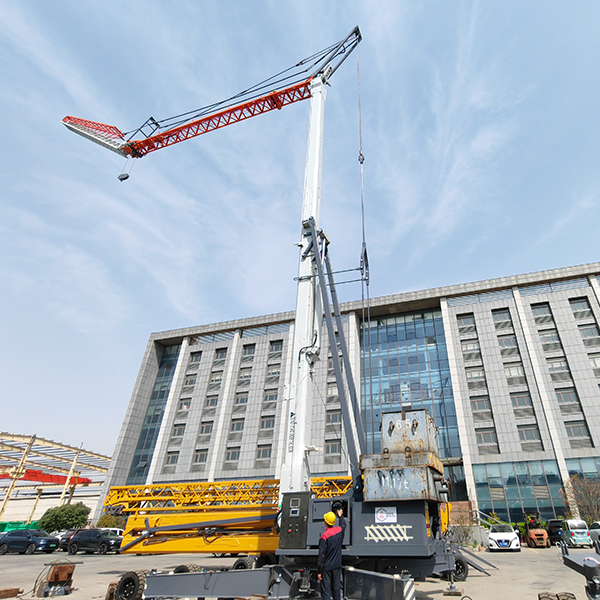
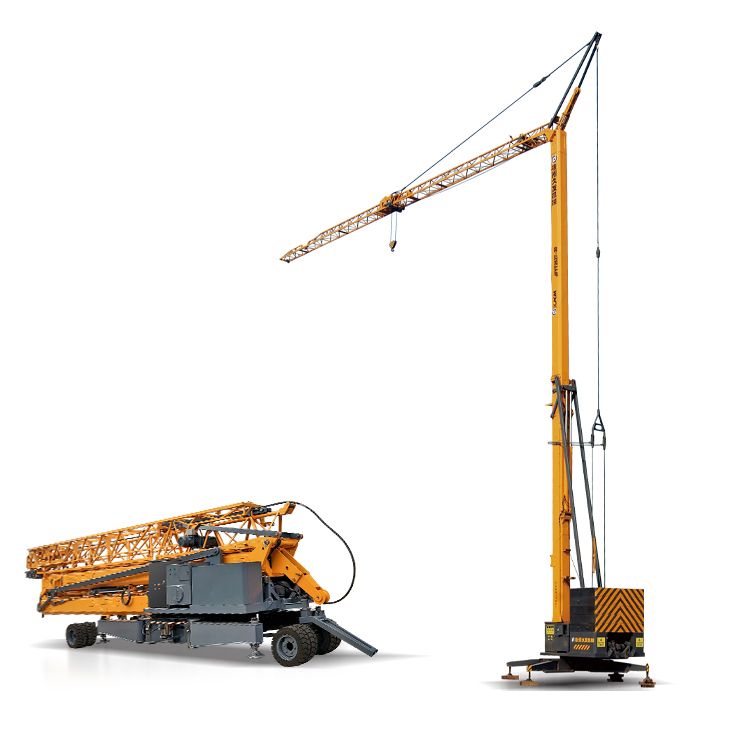
Here is the single biggest advantage: a self-erecting tower crane arrives on a single trailer and unfolds itself in under 30 minutes — no assist crane, no bolted foundation, no week of prep work. The entire machine telescopes upward using hydraulic cylinders, locks into position, and is ready to lift.
Traditional tower cranes need a poured concrete foundation that takes days to cure, a separate mobile crane to assemble sections, and a dedicated crew of 4–6 riggers. That makes economic sense on a 24-month high-rise project. It makes zero sense on a 3-month residential build.
Key Mechanical Differences
- Ballast counterweight system:Concrete or steel ballast blocks sit on the base frame, eliminating the need for ground anchors or foundations.
- Folding mast and jib:The mast sections and jib fold for transport, then hydraulically erect on-site.
- Remote control operation:Most modern self-erecting cranes use remote control systems so a single operator on the ground can position loads with full visibility — no cab climb required.
- Compact transport dimensions:Total transport length typically under 15 m, width under 2.5 m — legal for standard road haulage without special permits in most countries.
Capacity Range: Matching Tonnage to Your Project Needs
Most buyers overthink capacity. The real question is not “what is the maximum I might ever lift?” but “what do I lift most frequently, and at what radius?”
The 1–2 Ton Class
Perfect for residential renovations, roofing projects, and small commercial fit-outs. Think pallets of bricks (typically 1.0–1.2 tons), bundles of timber framing, pre-fabricated wall panels, and roofing materials. At XJCM, our 1–2 ton portable tower cranes reach jib lengths of 18–25 m — enough to cover most residential lots from a single position.
The 2–4 Ton Class
This is where you step into small commercial territory: precast concrete panels, steel beams, mechanical plant equipment, and formwork systems. A 4-ton self-erecting crane with a 30 m jib can service a 4–5 story building footprint without repositioning. For a contractor building a small apartment block in a dense African or Southeast Asian urban center, this class eliminates the need to hire a truck crane every time heavy materials arrive on-site.
Load Chart Reality Check
Remember: rated capacity is always at minimum radius. A crane rated at 4 tons might only lift 1.0 ton at maximum jib tip. Always request the full load chart and map it against your actual lift plan — not just the headline number.
Site Logistics: Will It Actually Fit?
The number-one reason contractors choose self-erecting cranes over traditional towers is the footprint. But “compact” still means you need to plan carefully.
Ground Bearing Pressure
Self-erecting cranes distribute load through their base frame and ballast. Typical ground bearing pressure ranges from 5–8 tonnes/m². Most compacted gravel or existing concrete slabs handle this without issue. Soft ground? You will need timber mats or steel plates — still far simpler than pouring a foundation.
Swing Radius Clearance
The counterweight tail swing is the hidden space-eater. On a typical 2-ton self-erecting crane, the tail swing radius is 3.5–4.5 m from center. That means you need at least that much clearance behind the crane to neighboring walls, fences, or public sidewalks. In many jurisdictions, you can oversail neighboring properties with the jib (with permission or permits), but the tail swing must stay within your site boundary.
Access for Delivery
The transport trailer needs a straight run or gentle curve to position the crane. Minimum access width is typically 3 m, with at least 15 m of length for the trailer. Plan the crane position so the trailer can enter, drop, and exit without a 47-point turn on a narrow street.
Real-World Example: 3-Story Infill Housing in Nairobi
A Kenyan contractor building a cluster of 3-story residential units on a 400 m² urban lot faced a common problem: the site was surrounded on three sides by existing buildings, with only a 4 m wide access road. Hiring a mobile crane for each concrete pour and steel delivery meant road closures, permit fees, and half-day wait times.
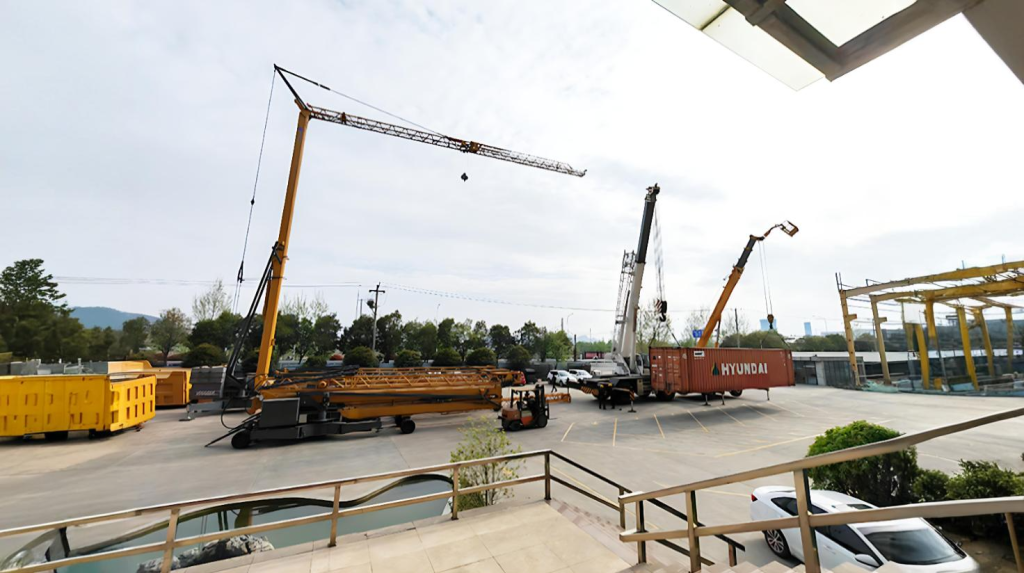
They deployed a 2-ton XJCM self-erecting crane with a 24 m jib. Setup took 25 minutes. The crane stayed on-site for 14 weeks, handling all material lifts — concrete skips, rebar bundles, block pallets, and formwork panels. The contractor estimated savings of $12,000–$15,000 compared to repeated mobile crane hires, plus a 3-week schedule acceleration because materials moved the moment they arrived rather than waiting for crane availability.
The key lesson: for projects lasting more than 2–3 weeks with regular lifting needs, a self-erecting crane almost always beats repeated mobile crane bookings on both cost and schedule.
Cost Factors: Purchase vs. Rental Economics
Should you buy or rent? The math is straightforward once you know your annual utilization.
Rental Breakeven
Self-erecting crane rental rates vary by market, but a typical 2-ton unit rents for $3,000–$6,000/month including transport and setup in most developing markets. If you need a crane for more than 8–10 months per year across multiple projects, purchasing makes financial sense. XJCM units in the 1–4 ton range are priced competitively enough that many contractors achieve payback within 12–18 months of ownership.
Hidden Costs to Budget For
- Transport between sites:You will need a suitable tractor unit and low-loader trailer, or a contract haulier.
- Ballast blocks:Some manufacturers ship without ballast to reduce freight costs. Budget for local sourcing of concrete counterweights.
- Annual inspection and certification:Most countries require periodic structural inspection — factor in $500–$1,500 annually.
- Operator training:Even with remote control, operators need training on load charts, wind limits, and signaling. XJCM provides on-site training as part of after-sales support.
Wind and Weather: Operating Limits You Cannot Ignore
Self-erecting cranes have lower wind tolerance than their larger cousins. This is not a weakness — it is physics. Lighter structures with shorter masts experience proportionally higher wind loads relative to their mass.
Typical Limits
Most self-erecting cranes are rated for operation up to 45–55 km/h wind speed (Beaufort force 6–7). Above that, you must stop operations and ensure the jib can weathervane freely. In storm conditions exceeding 72 km/h, the crane should be lowered to transport position if time permits.
For projects in coastal or elevated locations, this matters. A contractor in the Middle East dealing with seasonal shamal winds needs to plan around 2–3 weeks of potential downtime per year. Understanding maximum wind speed crane operation limits before purchase prevents unpleasant surprises.
Practical Tip
Install a simple anemometer on the jib tip. Many modern self-erecting cranes include one as standard, with automatic warnings at 80% of rated wind speed. If yours does not have one, retrofit costs under $300 and could prevent a catastrophic incident.
Choosing Between Self-Erecting and Mobile Cranes
This is the decision most contractors wrestle with. Here is the simple rule: if you need lifting on more than 5 separate days across a project, a self-erecting crane wins. If you need one or two big lifts and you are done, call a mobile crane.
When a Mobile Crane is Better
- Single heavy lifts exceeding 4 tons (HVAC units, generators, structural steel).
- Projects under 1 week duration.
- Sites with no space for a crane to remain between lifts.
When a Self-Erecting Crane is Better
- Ongoing material distribution over weeks or months.
- Repetitive lifts: concrete pours, block deliveries, panel installation.
- Sites where road closures for mobile crane setup are impractical or expensive.
- Projects where a mobile carry crane cannot reach upper floors due to limited boom length in tight quarters.
The comparison table above summarizes the key trade-offs at a glance.
Setup Process: What to Expect on Day One
Knowing the setup sequence helps you plan your site program and avoid embarrassing delays in front of the client.
Step-by-Step Deployment
- Site preparation (1–2 hours before arrival):Level the crane pad area to within 1° using a laser level. Lay timber mats or steel plates if ground is soft. Mark the crane center position.
- Trailer positioning (10–15 minutes):Back the transport trailer into the crane position. Extend hydraulic outriggers to stabilize.
- Ballast installation (15–30 minutes):Place counterweight blocks onto the base frame using the trailer-mounted crane or a small telehandler.
- Erection sequence (10–20 minutes):Activate the hydraulic erection system. The mast telescopes upward, the jib unfolds, and the crane locks into working position. All controlled from a single pendant or remote.
- Commissioning checks (10 minutes):Test all motions — slew, hoist, trolley, luff. Verify limit switches. Confirm load moment indicator readings against the load chart.
Total elapsed time from trailer arrival to first lift: typically 45–90 minutes. Compare that to 2–3 days for a conventional tower crane and you understand why self-erecting machines dominate the small project market.
Maintenance and Longevity: Protecting Your Investment
Self-erecting cranes are mechanically simpler than traditional towers — fewer bolted connections, no climbing frames, no embedded foundation anchors. But they still need attention.
Daily Checks (5 minutes)
- Visual inspection of wire ropes for broken strands or kinks.
- Check hydraulic hoses for leaks or chafing.
- Confirm all safety devices (limit switches, LMI) are functional.
- Inspect hook block, safety latch, and sheaves.
Monthly Maintenance
- Grease all slew ring teeth and bearing.
- Check hydraulic oil level and condition.
- Inspect electrical connections and remote control battery condition.
- Torque-check critical bolted joints (mast pins, jib connections).
Lifespan Expectations
A well-maintained self-erecting crane from a quality manufacturer lasts 15–20 years or 15,000+ operating hours. XJCM units are built with high-strength structural steel and undergo full non-destructive testing at the factory — the same standards applied to our full range of self-erecting cranes. Cutting corners on maintenance shortens that lifespan dramatically. Rope replacement alone, if neglected, can lead to catastrophic failure.
Making the Right Choice for Your Next Urban Project
Self-erecting tower cranes are not a compromise — they are purpose-built for exactly the kind of work that dominates urban construction today: infill housing, renovations, small commercial builds, and modular construction. If your project involves repeated lifts of 1–4 tons over several weeks on a constrained site, this is your machine.
Start by mapping your heaviest lift at maximum radius against the load chart. Confirm your site access can handle a 15 m trailer. Budget for ballast and operator training. Then get lifting on day one instead of day seven.
XJCM has been manufacturing self-erecting tower cranes with capacities from 1 to 4 tons for over two decades, with units operating across 40+ countries. Our engineering team can help you match the right model to your project parameters — including custom configurations for specific site constraints. Reach out through cnxjcm.com to discuss your requirements or request a detailed load chart for your target lift scenario.


